dairy-free

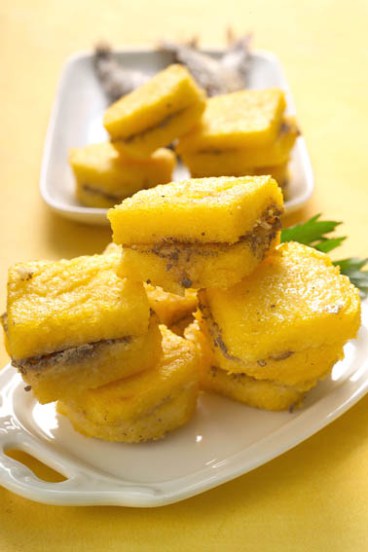
Rebecchini - Fried Polenta Sandwiches

Image

Maize polenta is creamy, delicious and filling, and for centuries represented the main staple in the poor, everyday cuisine of a large part of Northern Italy. Once it cools off and hardens, it can be recycled into a variety of dishes, from a “pasticcio” with meat or cheeses, to a cake, to these savory fried sandwiches (a classic Jewish Italian recipe, and perfect for Hanukkah). If you don’t like anchovies ( I LOVE them!), you can replace them with smoked cheese.

If you have never made polenta before, check out these detailed instructions on one of my favorite Italian food blogs in English, Memorie di Angelina.

  • 1 cup polenta (finely ground or quick cooking)
  • salt (about 1 tsp)
  • water to make polenta (follow instruction on the package, or about 3 cups)
  • 12 anchovies (salt packed is better, but oil-packed is OK))
  • 4-5 tbsps extra-virgin olive oil to make anchovy paste
  • 1 clove garlic (whole)
  • dredging flour
  • 3 eggs
  • olive oil for frying

In a large heavy pot, boil water and add salt. Pour in the corn meal in a thin stream whisking vigorously (use a whisk, not a spoon, to avoid clumping) and cook for about one minute or two before switching to a wooden spoon as the polenta thickens. Keep stirring until the polenta is fully cooked (about 30 minutes for regular polenta, and 3-5 minutes for “instant” polenta). Pour onto an oiled marble surface or cookie sheet or parchment paper. Spread out flat in a layer that’s about 1/4-inch thick, and allow to cool completely.

In the meantime, rinse the anchovies (removing any bones). Heat olive oil in a small skillet on medium heat with the garlic clove. When the garlic is light brown, discard it and add the anchovies, stirring until they melt into a paste. Set aside.

Pour about 2” oil into a heavy-bottomed wide pot with tall sides (I use my le Creuset Dutch oven) or into your deep fryer. Heat the oil until it forms many tiny bubbles around a piece of bread or cracker thrown into the oil. If you have a candy thermometer, or are using a deep fryer, the right temperature is about 355 to 365 F.

Using a knife or a cookie cutter, cut the polenta into regular triangles or rounds about 2” wide.

Spread half of the polenta pieces with the anchovy paste and cover with a second piece, making “sandwiches. Dredge the sandwiches in flour and then in the slightly beaten eggs, and fry for about 2 to 4 minutes or until golden brown, making sure to maintain the temperature of the oil and to flip them only once (if you keep turning them, they absorb more oil).

Drain on a triple layer of paper towel and serve hot.

Categories: Appetizer, Comfort food, Cucina Ebraica, dairy-free, first course, Hanukkah, Jewish Italian Cuisine, non-dairy, Uncategorized | Tags: , , , , , , , , , , , , | 9 Comments

Venetian Pumpkin Fritters

Pumpkin arrived in Italy after the discovery of the Americas, and Northern Italian Jews liked it so much that in Venice we called our favorite type “suca baruca” (holy pumpkin, from the Hebrew “baruch”).
When it made its first appearance, Venice in general -and Jewish Venice in particular – was a crossroad of peoples and cultures, in which countless examples of what we would now call “Fusion” cuisine came to life. These fritters, which include spices and candied fruit, are a perfect example!

This recipe was published in the Dining Section of the New York Times, Dec 21, 2011.

Ingredients

  • 1 pound pumpkin or butternut squash, cleaned and diced small
  • 2 eggs
  • grated zest of 2 oranges
  • ¾ cup of sugar and a pinch of salt
  • 1 and ½ cups flour
  • ½ package (8 gr) baking powder
  • ½ teaspoon cinnamon, if liked
  • 1/3 cup Raisins or Sultanas
  • 1/3 cup pine nuts
  • 1/3 cup candied etrog or lemon (if you don’t like it, skip & increase raisins & pine nuts)
  • Olive oil or peanut oil for deep-frying, at least 3 cups or more
  • Confectioner’s sugar for decorating

Directions

Plump the raisins in a cup of warm water. Chop the candied zest.

Place the diced squash in a large platter and cover almost completely, leaving a small opening for the steam to come out, and microwave on high for 10 minutes or until very tender.
Beat the eggs in a food processor with the sugar, salt, cinnamon, orange zest; add the cooked squash and process until smooth.
Drain and dry the raisins, and add them to the mix.
Transfer to a large bowl and gradually add the flour, sifted with the baking powder, using an electric or manual whisk.
In a frying pan, heat the oil to frying temperature (you can test it by dropping a small piece of bread in the oil: if bubbles form around the bread, the temperature is right). Take the batter with a tablespoon, filling it to about ½, and push the batter into the oil with your index finger or a second spoon. The batter should be quite wet and liquid and you won’t be able to shape it: this is normal! You will let it drop into the hot oil and it will puff up quickly, forming the fritters. You will also end up with drops, that would turn into crumbs. Don’t worry about these: you can just discard them every time you take out a ready batch of fritters… or you’ll end up eating them all, like I always do Fry in small batches until golden all over, turning to cook evenly. Remove with a slotted spoon and transfer onto a platter lined with several layers of paper towels.

Sprinkle with powdered sugar right before serving (serve warm).

Ed

Categories: Cucina Ebraica, dairy-free, Desserts, Hanukkah, Jewish Italian Cuisine | Tags: , , , , , , , , , , , , , , , , | 3 Comments

Fried Chicken Cutlets, Italian-Jewish Style - by Jayne Cohen

Image

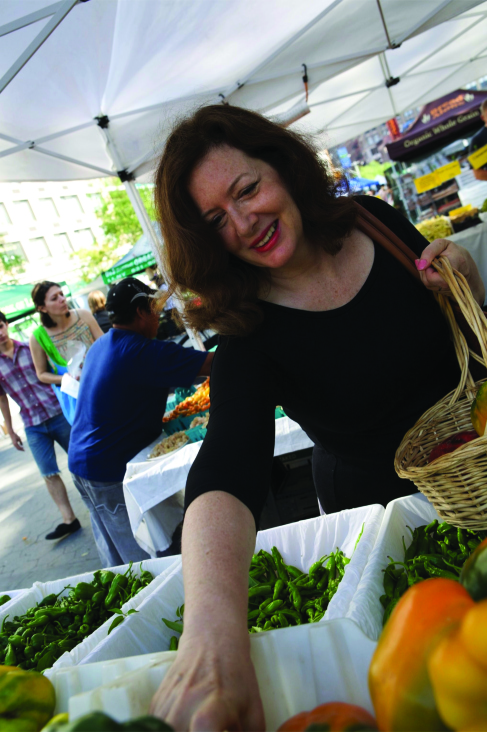
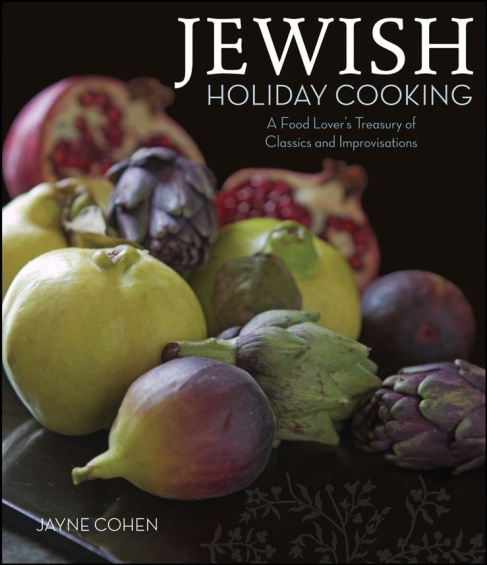
Today I have a very special surprise for you: a guest post by my friend Jayne Cohen, a food writer and expert whose passion for Italy and its cuisine should earn her an honorary Italian passport. Among many other accomplishments, Jayne is the author of one of my most treasured cookbooks, Jewish Holiday Cooking, which includes 200 tasteful, elegant and special recipes for the holidays. My personal favorite is her hamantaschen with dates and pistachios (yum!).
Image

Visit her blog, Beyond Brisket, on JWI Magazine! For Hanukkah, Jayne is sharing her version of Italian Fried Chicken, and her memories of Casale Monferrato: enjoy!

A Hanukkah Story from Casale Monferrato

Text and recipe adapted from Jewish Holiday Cooking: A Food Lover’s Treasury of Classics and Improvisations by Jayne Cohen(print and e-book, John Wiley & Sons)

Like most travelers, we were lured by the taste of Barolo, the scent of truffles and extraordinary hazelnuts, but what we will remember most about Piedmont is the synagogue we found in Casale Monferrato.

The small Jewish community in Casale, located about fifty miles east of Turin, most likely began with the refugees Ferdinand and Isabella expelled from Spain in 1492. Although there were periods of crisis and some restrictions, life under the Italian Gonzaga dukes was relatively calm for the Jews, even prosperous for some. The synagogue was built in 1595.

But when the French House of Savoy annexed the district, conditions quickly deteriorated. In 1745, Jews were crowded into a ghetto around the synagogue. Contacts between Jews and Catholics were limited, and at night they were strictly forbidden. Not until 1848 were the Jews of Piedmont granted full rights.

Now there are no longer enough Jews to make a minyan in Casale, except on the High Holidays, when Jews from other communities attend the services.

From the narrow little street, La Sinagoga degli Argenti looked like one of the apartment buildings, but inside was one of the most exquisite synagogues we have ever seen. It was late afternoon in July, and light filtered through the windows of the sanctuary highlighting for us the subtle pastels, gilded carved symbols, and gold filigree work. Our guide-who like one we had had years ago in Venice, was not Jewish but extremely knowledgeable about the synagogue and Jewish life-pointed out the beautifully painted ceiling, a fresco of sky and clouds, whose panels announce in four Hebrew words, “This is the Gate to Heaven.”

There is also an impressive museum, showcasing art and furnishings acquired from other Piedmont congregations, antique dealers, and private collections, and life-size dioramas of many of the holidays. The basement of the museum, where matzoh once was baked for all the Jews of the Monferrato region, now houses the Museum of Lights, a remarkable collection of menorahs.

The Hanukkah story of the tiny flame that produced a lasting light is the story of Jewish continuity, and the Jewish community of Casale has adopted it as its own. The museum commissions new hanukkiyot from renowned contemporary artists, Jewish and non-Jewish, who, in the museum’s words, “form a bridge between the lights of the past, which must never go out, and those of the future, which must continue to be lit.” One menorah is formed of two sculpted hands, the thumbs entwined to form the shamash, the flames shooting up from the fingertips; another was inspired by the notes people insert into the cracks of the Western Wall.

In the courtyard, our guide told us that for the past several years, the synagogue has invited members of all the other monotheistic faiths in the area when Hanukkah begins. Another Hanukkah story-a miracle too, perhaps-that has particular resonance for Casale.

For it would be dark, of course, when the Catholics, Muslims, Protestants, and Jews gathered to light the menorah candles here between the elegant colonnaded courtyard columns-where once upon a time any contact between Jews and Gentiles after nightfall would have been prohibited.

“Hanukkah,” as Antonio Recalcati, one of the Catholic menorah artists has said, “celebrates life and light after centuries of darkness.”

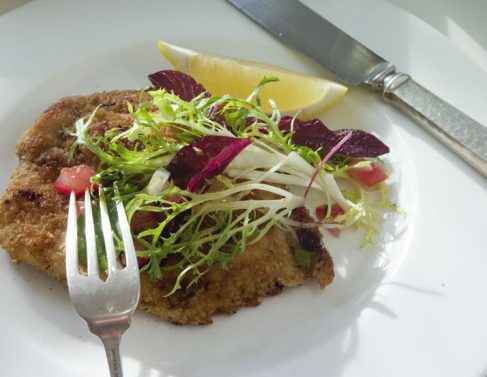
Fried Chicken Cutlets, Italian-Jewish Style

”The logs of Jerusalem were of the cinnamon tree, and when lit, their fragrance pervaded the whole of Erez Israel.”-Babylonian Talmud: Shabbat

Jews have appreciated sweet-smelling cinnamon since ancient times. Centuries later in Europe even poor Jews usually had access to the spice: inhaling its heady aroma was central to the Havdalah ceremony that ushered out their Sabbath every week.

This fried chicken lightly flavored with cinnamon is a traditional Hanukkah specialty in Italy. Used without any sweetening, the cinnamon acts in concert here with savory garlic and lemon to produce a very fragrant yet subtle marinade. Because of the Havdalah connection, it makes an especially lovely main course on the Saturday night that occurs during Hanukkah week.

To accentuate the delicacy of the dish, I dip the chicken in egg after dusting it lightly with matzoh meal. And I fry each batch with a few pieces of celery-a trick sent in to Cook’s Illustrated magazine by one of its readers-which makes the chicken beautifully golden and more flavorful.

Yield: 3 to 4 servings

Ingredients:

  • 1/4 teaspoon ground cinnamon
  • 4 large garlic cloves, finely chopped (about 1 1/2 tablespoons)
  • 3 tablespoons fresh lemon juice
  • 1 tablespoon olive oil, plus additional for frying
  • Salt and freshly ground black pepper
  • 1 1/2 pounds skinless, boneless chicken cutlets, trimmed of fat and gristle
  • About 1 cup matzoh meal (use commercially ground-you’ll need a very fine, powdery consistency here)
  • 2 large eggs
  • 2 or 3 celery stalks, including leaves, washed, dried well, and cut into 4- to 5-inch lengths
  • Accompaniment: lemon wedges
  • Optional garnish: parsley sprigs

In a large bowl or nonreactive baking dish, whisk together the cinnamon, garlic, lemon juice, olive oil, and salt and pepper to taste. Add the chicken and toss to coat thoroughly. Cover and marinate for 2 to 3 hours in the refrigerator, turning the chicken occasionally. Or marinate the chicken in a large, resealable plastic bag.

Set up a work station near the stove. Spread 1 cup matzoh meal on a large sheet of wax paper or a plate and season it with 1 teaspoon salt and 1/8 teaspoon pepper, or to taste. Next to it, in a wide shallow bowl or pie pan, beat the eggs with a few drops of water until well blended and smooth.

Dredge the cutlets well with the matzoh meal, rubbing it lightly into the chicken. Make sure each cutlet is covered all over with meal. If necessary, add more matzoh meal, remembering to add more seasoning.

Heat about 1/2 cup olive oil in a 10- to 12-inch heavy skillet over medium-high heat until hot and fragrant but not smoking. Shake a cutlet to remove all excess matzoh meal, then coat it thoroughly with the egg and slip it quickly into the hot oil. Being careful not to crowd the pan, add more chicken, dipping each piece in the egg just before placing it in the pan. Slip a few pieces of celery in between the cutlets as they fry. Using two spatulas (tongs would ruin the delicate egg coating), carefully turn the chicken when it is light golden, 2 to 3 minutes. Sauté the other side for 2 to 3 minutes longer, until cooked through. Turn the celery pieces when you turn the chicken. Transfer the cutlets to a platter lined with paper towels so they can drain. Discard the cooked celery. Keep the chicken warm in a 200 degree F oven until the remaining pieces are done. Continue frying any remaining chicken in batches, in the same way, adding fresh celery to the pan with each batch. Wipe out the skillet and replace the oil if some of the coating falls off and burns.

Serve the chicken right away, accompanied by the lemon wedges and garnished, if you’d like, with fresh parsley. It really needs no sauce.
Image

Categories: Cooking, Cucina Ebraica, dairy-free, Hanukkah, Jewish Italian Cuisine, non-dairy, Uncategorized | Tags: , , , , , , , , , | 4 Comments

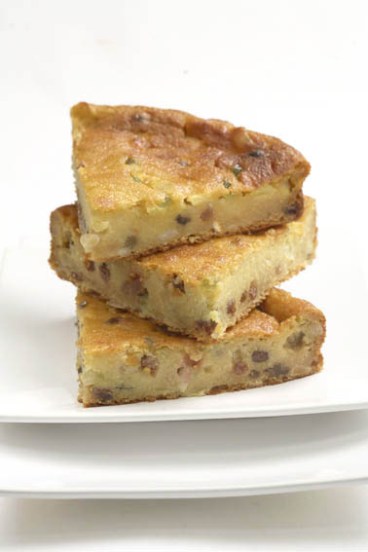
Thanksgiving Cornmeal Cake from the Veneto

Image

It was eight years ago, just a few months after moving to the City, that I experienced my first Manhattan Thanksgiving: ironically, I ended up celebrating the quintessential American holiday at an Italian friend’s home. Daniela had arrived in New York one year before me, and was so smitten with it that she scored higher on the Time Out Magazine test “Are You a Real NewYorker?” than all our American friends. It was her idea to throw an Italian-style Thanksgiving dinner, incorporating the various traditional foods of the holiday into Italian recipes. Given that she is a superb cook, carrying the extraordinary legacy of three different Jewish Italian culinary styles – the Piedmontese, the Venetian and the Ferrarese - it’s no surprise that the meal was an absolute masterpiece. I had the impression that for the American guests, eating these Italian delicacies instead of the classic turkey with cranberry sauce also felt a little naughty! While I can’t replicate the special atmosphere of that night, after Daniela moved to Israel I adopted her tradition of remembering the Pilgrims with the regional dishes from my own country.

I’m used to cooking around symbolic foods for Passover and Rosh haShana: turkey and pumpkin, the most recognizable Thanksgiving ingredients, also appear on my Rosh HaShana table, and again on Sukkot. The connection with Sukkot runs even deeper, as both holidays are harvest festivals: some historians have gone so far as to trace the roots of Thanksgiving in Sukkot, based on encounters the Pilgrims supposedly had with Sephardic Jews in Holland before they left for the Americas.

But whether or not this story is true, Jews celebrate Thanksgiving Day with an intensity usually reserved to our most sacred holidays: it’s easy for us to empathize with the pilgrims, who had to flee religious discrimination and persecution and travel across an ocean to find freedom – and with their sweat and faith, fought against illness and scarcity, finally turning America’s wilderness into their “Promised Land”.

While the turkey and pumpkin are symbols of bounty, one food on the table is meant to remind us of the harsh winter before the first harvest, when the pilgrims barely had enough to eat. It’s the corn, as it is said that at one point there was so little food that each person was given only five kernels of corn per day. Corn bears a similar type of double-symbolism in Italian history: when it found its way to Italy from the Americas, it immediately spread through the North, and landowners started reaping huge profits by feeding their workers only maize polenta – creamy, delicious and filling, but so poor of vitamins and protein that it caused an epidemic of Pellagra, the same deficiency disease that spread in the American South during the great Depression, leading to deterioration and death. Somehow, native Americans had avoided it because they added wood ashes and lime to cornmeal, correcting its nutritional imbalance.

Cranberries can also be read as a symbol of suffering: of course we combine them with a lot of sugar to make them palatable, but their nature is extremely sour. This reminds me of the symbolism of sweet and sour dishes in Jewish Italian Cuisine, in which the sugar or honey represent the need to appreciate our present and future, while the vinegar or lemon keeps us rooted in our people’s past suffering.

While giving thanks for the plentiful new crop, and the many blessings that we enjoy each year, we also remember those who didn’t make it through that terrible first winter. 
Have a meaningful Thanksgiving!

Ingredients

  • 1 scant cup (150 gr) cornmeal maize (for polenta) or 2 cups cooked polenta (cooked dense, not liquidy)
  • 3 tbsps grappa or brandy
  • 1/3 cup dried cranberries (or raisins)
  • 1/2 to 2/3 cup candied fruit (mix of orange and lemon or citron) (optional)
  • 1/4 cup pine nuts
  • 1 organic lemon
  • a pinch of salt
  • 1/3 cup of sugar (about 85 gr)
  • 1 scant cup flour (about 100 gr)
  • 1 1/2 tbsp baking powder (10 gr)
  • 1/4 cup oil (mild olive oil , vegetable oil or coconut oil)
  • 2 eggs

Preheat the oven to 400 F. Prepare the polenta with one scant cup of maize according to instructions on the package, using only about 1 1/4 cup boiling water (traditional polenta tastes better than instant, and you can make it quickly using a pressure cooker… however, instant is OK! Beretta makes a nice product). The polenta has to be on the thick side. 
When cooked, pour it over a large cutting board or platter in a wide and low heap and allow it to cool (feel free to pop it into the fridge).
 Plump the cranberries or raisins in the grappa or brandy. Dice the candied fruit very small. Discard the film that has formed over the polenta. Cut the polenta into pieces and place it into a food processor. Process it with the eggs, salt, sugar, oil, sifted flour with baking powder; add the raisins in their liqueur, the candied fruit, pine nuts, and the lemon zest and mix well. If the batter is so thick that it’s hard to pour into the pan, you can add just a couple of spoonsfuls of water or non-dairy milk.
Grease a 9″ springform pan and dust it with corn meal. If you have parchment, you should line the bottom of the pan before greasing it: this type of batter is very sticky. Pour the mix into it and bake in a pre-heated 400 F oven for about 15 minutes until it forms a golden crust, then lower the heat to 350 and bake for another 30-45 minutes (the cake should bake for 45-60 minutes total). Allow to cool before turning out. Serve warm, sprinkled with confectioner’s sugar.

Categories: Comfort food, Cucina Ebraica, dairy-free, Desserts | Tags: , , , , , , , , , , , | 11 Comments

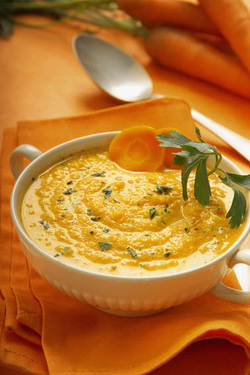
Carrot Cream Soup - cream-less and dairy-free

Creamy Cream-Less Carrot Soup (Parve) GF

In Italy, creamy soups - or “vellutate” - are not usually made with cream (an ingredient that we like to leave to the French): the texture is given by the addition of a simple potato or a handful of rice.

The starches in the rice are slowly released during the cooking, and act as a thickener and an emulsifier at the same time. Slowly-released starches are what gives creaminess to authentic risottos, and also the reason why we add the pasta cooking water to our sauce (the starches released by the pasta turn the cooking water into an emulsifier, and a thickener). Better than fairy dust! This method obviously helps limit saturated fats, but it’s also a great resource for the dairy-intolerant, or the kosher cooks who need dairy-free dishes to serve with meat.

If you love smooth textures, you can turn any vegetable soup into a vellutata simply by throwing in a boiled potato and some water and processing everything in the blender. An easy way to recycle your second-day minestrone!

Ingredients (serves 4 to 6):

  • 2 pounds carrots
  • 1 onion
  • 1 celery stick
  • 1 ½ quarts vegetable stock or to taste
  • 2 garlic cloves
  • 4 or more tablepoons extra-virgin olive oil
  • ½ cup Italian rice (short grain - Arborio, Carnaroli or Vialone)
  • 1 ½ tablespoons of freshly chopped parsley (or basil/parsley mix)
  • 1 bay leaf
  • salt and pepper to taste

Directions

Peel the carrots and slice them thinly.
Chop the celery, onion and garlic very finely.
Heat 2 tablespoons oil in a heavy pot and cook the mix of celery, onion and garlic ( “il soffritto“) on medium/low heat for about 5 minutes. Add the carrots and the bay leaf and cook for 5 more minutes. Add 2/3 of the hot stock and bring to a boil, then add the rice, lower the heat, cover almost completely, and allow to simmer for about an hour.
Discard the bay leaf, process with a hand mixer, add the rest of the hot stock and the herbs, and allow to simmer uncovered for 5 more minutes, stirring continuosly. Drizzle with 2 more tablespoons of olive oil, sprinkle with black pepper and serve.

Categories: Comfort food, dairy-free, light and healthy, non-dairy, Soup | Tags: , , , , , , , , , , | 5 Comments

Blog at WordPress.com. Theme: Adventure Journal by Contexture International.

Follow

Get every new post delivered to your Inbox.

Join 1,900 other followers